



In 2025, London gives the impression of having reached saturation point with pop-up stores. Selfridges continues to reinvent its Corner Shop, Regent Street hosts one collaboration after another in women’s sportswear, and Mayfair now showcases entire townhouses devoted to temporary rental fashion concepts. Across the city, luxury’s landscape feels shaped by the ephemeral. Yet with every new activation, the effect of surprise weakens. The conversation is shifting: the question for luxury brands isn’t about why they should open a pop-up, but how to ensure the format still resonates.
The Format at Risk of Losing Its Edge
What began as a bold expression of retail experimentation has gradually become an expected component of brand strategy. Pop-ups that once relied on exclusivity, anticipation, and visual impact are now commonplace. Prada’s private ‘Mode’ club, Aurélien’s refined menswear showcase, and Isabel Marant’s debut at Selfridges all contribute to this abundance. The paradox is simple: the more we try to surprise consumers, the less surprised they become. Yet ubiquity does not mean irrelevance. When reimagined with intention, the pop-up still has room to provoke emotion—if its purpose extends beyond commercial tactics.
A Shift Toward Experience Over Transaction
Emporio Armani’s recent residency at the Selfridges Corner Shop demonstrates how far the temporary format can stretch. The stripped-back scenography—steel, concrete, quiet geometry—was the foundation for a multisensory journey that intertwined fashion with gastronomy, design, and floristry. Armani/Dolci tastings, Armani/Fiori arrangements, and curated Armani/Libri selections created an atmosphere centred on cultural refinement rather than impulse buying. It was a reminder that the memorability of a space often outlasts the products displayed within it.
By Rotation’s “House of ByRo” took this logic in a different direction. Installed in a five-storey Mayfair townhouse, the concept fused digital community with circular fashion. Rental couture, celebrity wardrobes, and Huntsman’s archival menswear were brought together under one roof. The result was a demonstration of “responsible luxury” that connected contemporary lifestyles with sustainability. In both cases, the value emerged from narrative clarity—not novelty for novelty’s sake.
Local Insight, Global Narrative
Many of 2025’s most successful pop-ups avoid redundancy by embedding themselves into London’s cultural tempo. Tracksmith’s Spence Residency aligned perfectly with the Wimbledon season, becoming a natural meeting point for sport and style. Pink City Prints mirrored the spirit of the Chelsea Flower Show through Jaipur-inspired craftsmanship and tactile colour stories. These activations work because they complement the lived rhythm of the city rather than interrupt it.
Curation, Stillness, and the Return to Depth
Where early pop-ups thrived on spectacle, today’s most relevant spaces privilege curation and a slower pace. The Guardian once described luxury’s evolution as “a silent revolution,” and that sentiment echoes through projects like JW Anderson’s redesigned Soho store, where retail and gallery culture merge. The emphasis is placed on meaningful objects, handcrafted collaborations, and thoughtful browsing—an antidote to overstimulation.
Similarly, Lone Design Club’s revolving spaces at Battersea Power Station prioritise emerging sustainable brands and intimate gatherings. These smaller-scale, community-driven initiatives demonstrate that the future of ephemeral retail lies in offering depth rather than noise.
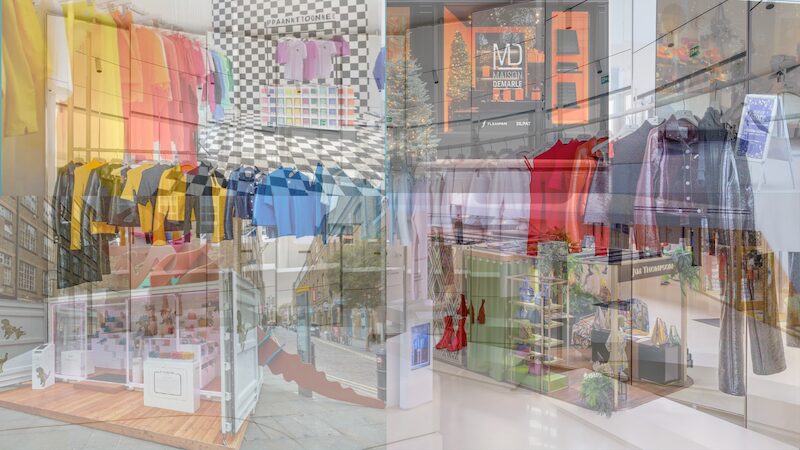
The Social Pull of Temporary Retail
Despite their sheer number, pop-ups maintain a strong place in consumer culture because they meet psychological needs that digital retail cannot replicate. They foster connection, immediacy, and shared experience. The Style Of Our Own collective on Regent Street achieved this through workshops, talks, and fitness activations, creating a sense of purpose-oriented community around women’s sportswear. Visitors weren’t passive shoppers—they were participants.
Yungblud’s B.R.A.T Store approached it differently, merging performance, visual art, and punk sensibility in Denmark Street. The appeal wasn’t the merchandise itself, but the rawness and authenticity of the moment—qualities that remain rare in an algorithm-driven environment.
The Home of Ephemeral Experimentation
Among global department stores, Selfridges continues to stand apart as the platform where luxury brands experiment freely with ephemeral formats. Its Corner Shop, in constant rotation, has become less a retail space and more a stage for storytelling. In 2025, this fluidity is an asset. Each temporary installation becomes a narrative chapter—brief, but carefully orchestrated.
Isabel Marant’s AW25 pop-up illustrated this beautifully. With its New Wave influences and subtle grunge undertones, the experience expressed the brand’s identity through contrast and ephemerality.
Reigniting the Spark of Discovery
What keeps consumers returning to these spaces is not scarcity or spectacle, but the promise of discovery. Visitors want to feel something: an invitation to explore, a tactile encounter, a sense of belonging, or simply a moment that breaks from routine. The most successful pop-ups create emotional coherence—spaces where story, craft, and intention align.
Emporio Armani’s installation worked because it appealed to the senses. House of ByRo resonated because it connected luxury with responsibility. Style Of Our Own succeeded because it built community. In each case, meaning outweighed novelty.
From Temporary to Transformative
In 2025, the pop-up is evolving from a transactional strategy into a transformative one. Its potential lies in translating a brand’s worldview into a temporary environment that feels alive and culturally aware. The formats that rely solely on aesthetics will fade quickly. Those that prioritise experimentation, responsibility, and human connection will continue to inspire.
London remains the ideal setting for this evolution—a city where heritage and innovation coexist, and where the ephemeral, when handled with purpose, still has the power to feel remarkable.