



Scandiweb, an e-commerce and enterprise systems agency, today announced two new operational applications built on OperaLayer, its operational-layer framework designed to help retailers, suppliers, and distributors respond to supply chain disruptions in real time.
The Stock and Shipment Control Cockpit and Exception Allocation App were developed in response to the ongoing Middle East shipping crisis, which has rerouted global container traffic and exposed how difficult it is for many legacy systems to adapt to operational uncertainty.

Container traffic through the Suez Canal has fallen by roughly 75% compared to pre-crisis levels. Ships rerouted around the Cape of Good Hood now add an average of 10 or more days to delivery times and traffic had still not normalized as of early 2026. For many retailers, the issue was not a lack of experienced operators. Their systems simply could not reflect the new operational reality quickly enough.
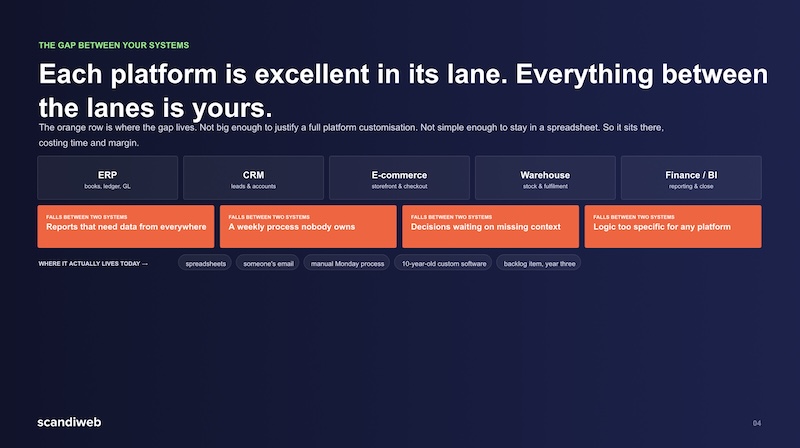
OperaLayer creates a fast, configurable layer above or between existing ERP, WMS and TMS platforms, consolidating data from those systems without replacing them. Scandiweb has already deployed OperaLayer-based solutions for several enterprise clients, including Sportland and ESELO across retail and distribution operations.
“In the furniture scenario, we were dealing with over 200 open purchase orders with no reliable status. Within three days, planners had a live view of every shipment and could act on exceptions the same day they appeared. That kind of turnaround isn’t possible through a standard legacy change request. The grocery and pharma distributor had expiry-sensitive lines being tracked in four different spreadsheets. Consolidating those into a ranked exception queue reduced duplicate data entry by an estimated 60–70 percent in the first week,” notes Antons Sapriko, Founder and Executive Chairman at scandiweb.
The two new applications extend that framework directly into disruption-response workflows. The Stock and Shipment Control Cockpit was deployed for a furniture, home and textile supplier whose legacy ERP system could not clearly distinguish between delayed, rerouted, blocked, or duplicated shipments. Sales teams were quoting outdated arrival dates, and planners were generating duplicate replenishment orders against stalled purchase orders. The cockpit consolidated open POs, warehouse stock, shipment updates, sales allocations and planner notes into a single operating view, with stock classified by status: available, allocated, at risk, or blocked for review.

The Exception Allocation App was built for a distributor managing grocery, pharmaceutical and B2B supply lines. Its planning system was still running on unreliable standard lead-time tables, with short-life products and critical stock tracked across ad-hoc spreadsheets. The app consolidated ERP orders, distribution center stock, shipment delay signals, expiry data and forecast inputs into a ranked exception queue for human planners to review and approve. Both applications were delivered as working MVPs within 72 hours.
Scandiweb delivers OperaLayer within a controlled framework covering information security, cloud security and quality management. Any customer data made available to external AI services is explicitly defined and confirmed with each customer prior to deployment. In the disruption scenarios described above, no external AI data transfer was required.