



Stone is setting the tone again
Walk through Bond Street or Mayfair in 2026, and one material reappears across the most considered fit-outs.
Natural stone, particularly honed marble, travertine, granite and quartzite, has returned to the centre of luxury retail and hospitality interior design. It is visible in jewellery areas, beauty halls, restaurants, hotel receptions and boutique hospitality schemes.
The shift is not subtle, and it is not accidental. It points to where high-end retail design is moving: away from flat commercial surfaces and towards materials that carry touch, theatre and brand memory.
The specification mood has changed
Natural stone has been one of the most sustained material stories in luxury interiors over the past five years, appearing across retail, hospitality, residential and commercial fit-outs. Coverage in Frame, Wallpaper, Dezeen and the interiors press has reflected the same movement: genuine materiality is back in favour.
Retail and hospitality designers are moving away from laminates, lacquered MDF, thin engineered alternatives and high-gloss finishes. Honed surfaces, sculptural proportions and visible veining are doing more of the design work.
For UK makers, the change is being felt at the workshop level. Steve Bristow Furniture, a UK family-owned maker founded by former artisan stonemason Steve Bristow, who has more than 30 years’ experience working with marble, travertine, granite and quartz, says retail and hospitality enquiries now form a meaningful part of its order book for handmade stone furniture.
Physical retail needs materials with presence
The return of stone sits closely alongside experiential retail. As e-commerce takes a larger share of transactional shopping, physical stores have to work harder as brand environments.
A customer may not read a material schedule, but they will notice weight, temperature, edge detail and texture. Stone rewards the hand as much as the eye.
Stone also helps with differentiation. In luxury and lifestyle categories, materiality becomes a signature. A marble consultation table or travertine plinth can suggest craft and investment without spelling it out.
There is a provenance layer too. Where quarry source, chain-of-custody information and responsible sourcing documentation are available, natural stone can support a clearer story around place, process, veining and stonemason craft.
Where stone is being used now
Stone is appearing most clearly where touch, consultation and dwell time matter.
In jewellery and fine watch environments, designers are using it for consultation tables, central counters and display plinths, particularly in flagship luxury districts such as Mayfair, Bond Street, the Champs-Élysées and Madison Avenue. Beauty and skincare flagships are specifying it for counters, fragrance bars and treatment spaces.
Fashion concept stores are using stone for styling tables, fitting room benches, accessory displays and lounge furniture. Restaurants and hospitality schemes are using it for dining tables, bar tops, host stations and private dining rooms.
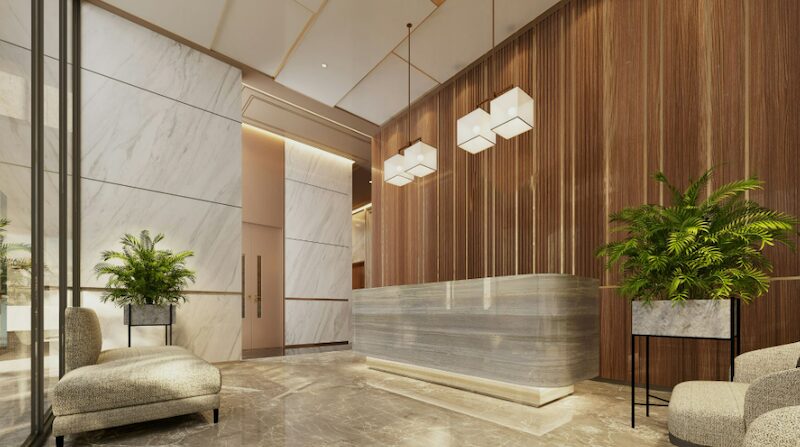
Boutique hotels, members’ clubs and VIP areas are part of the same movement, from reception desks and lobby tables to private appointment rooms.
Designers are specifying character, not uniformity
The current look is less polished and less perfect than the stone-heavy commercial interiors of previous decades.
Marble remains a key reference, with Carrara, Calacatta, Nero Marquina, Verde Alpi and Calacatta Viola chosen for veining and contrast. Travertine is prominent in warmer hospitality and retail schemes, helped by its softer palette and naturally pitted surface. Quartzite is considered where designers want natural character with stronger performance. Granite still has a role in high-traffic environments, while sintered alternatives can appear where durability, consistency or programme constraints demand them.
Forms have changed, too. Thin tops and simple metal legs are giving way to slab constructions, monolithic bases, fluted columns, block plinths, single-stem bases and paired drum forms. Multi-stone pairings, such as pale tops with darker bases, add depth in higher-tier hospitality schemes.
Custom finishes, including leathered, brushed and honed surfaces, are selected around lighting, touchpoints and use case. Bespoke proportions are increasingly important in heritage stores, listed buildings and irregular floorplates.
A maker’s view from the workshop
According to Paul Silk, General Manager at Steve Bristow Furniture, commercial enquiries have changed significantly over the past three years.
“Retail and hospitality briefs are much more developed than they used to be,” says Silk. “Designers are coming to us with full interior concepts, technical drawings, fit-out programmes and clear requirements around finish, durability and proportion.”
He says the strongest demand is for honed finishes, sculptural forms and slabs with visible character rather than the polished, uniform surfaces often associated with earlier commercial schemes.
“The clearest shift is the investment horizon. Brand owners want interiors that can work hard, patinate and still feel relevant after several years of use. Natural stone suits that because it develops character rather than simply looking tired.”
The stone needs to be planned early
Natural stone can bring depth and permanence to a retail or hospitality scheme, but it cannot be treated as a late decorative addition.
Lead times need to be built into the programme. Bespoke stone furniture can require six to twelve weeks, depending on material availability, complexity, slab selection and finishing.
Slab selection is part of the design process. Veining, tone and movement vary from one piece to another, so designers need to see that variation as part of the commission, not as a defect.
Weight and structural load must be considered, particularly in heritage stores, listed buildings and upper-floor fit-outs. Edge profiles matter too. Bullnose, ogee, mitred and eased details affect durability, comfort and visual weight.
Commercial-use stone needs sealing and maintenance planning. Designers also need to consider how stone interacts with timber, metal, fabric and lighting. Working with commercial makers can help align drawings, programme timings, durability requirements and installation practicalities.
Materials now have to earn their place
Natural stone’s return to luxury retail and hospitality design is not simply a decorative revival. It reflects a sustained shift in how brand owners think about physical retail, dwell time and fit-out lifespan.
For designers, the material has moved from accent specification to central material, supporting brand identity, merchandising, hospitality, consultation and the physical quality of the customer experience.
Working with UK and European stone specialists who understand programme integration, technical specification, durability, slab selection and provenance is becoming an important part of the retail design supply chain.
The most considered fit-outs of 2026 will not be defined by the cleverest digital integrations. They will be the spaces built around materials that reward touch, photograph with depth and age into themselves.