


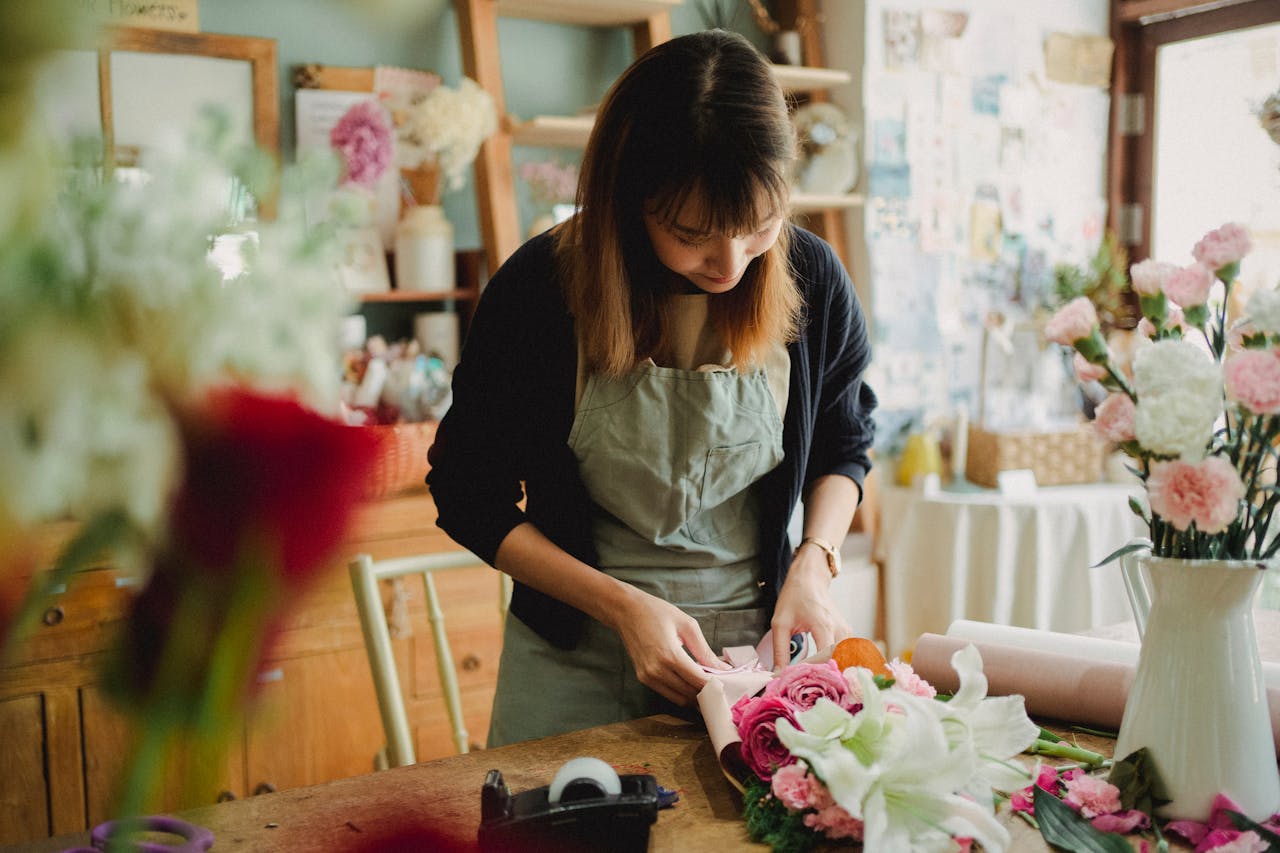
New research from The Faux Flower Company has found that the number of traditional high street florist shops in the UK has fallen from more than 8,000 in 2016 to around 5,500 today. That’s a drop of roughly a third in less than a decade. Drawing on industry data from National Florist Day and IBISWorld, the research tracks the contraction of the high street florist sector alongside the accelerating growth of the faux flower market to examine where displaced consumer spend is going.
The closures accelerated through the Brexit transition period and again during the pandemic years. Fresh flower retail revenue is on a declining trajectory of 0.6% compound annual growth rate through to 2025–26 per IBISWorld, with supermarkets and online florists identified as the primary beneficiaries of footfall lost from specialist shops. The UK already has the highest proportion of supermarket and online flower sales of any country in the world, with supermarkets accounting for approximately 54% of all flower purchases, compared to around 14% in France and 20% in the Netherlands, per Rabobank figures.
But the more telling shift identified in the research is happening in a category that traditional florists do not compete in at all.
The UK artificial flower market generated revenue of $314.7 million in 2023 and is projected to reach $429.3 million by 2030, growing at a compound annual rate of 4.8%, according to Grand View Research data cited in the analysis. That growth rate is running at eight times the pace of the fresh florist sector’s contraction.
Rachel Dunn, Head of Product at The Faux Flower Company, commented on the findings: “The high street florist has served communities well for generations, but the economics have become very difficult. What the data shows is that a meaningful share of the spend that used to go to local florists is now going online, and a growing portion of that is going to faux rather than fresh. Consumers are becoming more comfortable with quality artificial flowers as an everyday purchase, not just an occasional one.”
The research also found that Hobbycraft reported an 8% year-on-year increase in faux flower sales in 2022, which the retailer attributed to the category becoming a mainstream home decor purchase. The residential segment of the artificial flower market is projected to grow at 7.2% per year through 2030, per Grand View Research, outpacing commercial applications.
The structural drivers are clear. Fresh flower retail is heavily exposed to import costs, with the UK sourcing the vast majority of its cut flowers through the Netherlands. Brexit-related frictions, currency movements since 2016, and subsequent supply chain pressures have pushed input costs up for high street florists without a corresponding ability to raise prices in a market where supermarkets set the consumer’s reference point. Faux flower retailers operate outside that cost structure entirely: their products are bought once, carry no wastage, and require no cold chain.
“The consumer trading up to a quality faux arrangement is often the same consumer who used to buy fresh flowers from a local florist,” said Dunn. “They want something that looks considered and lasts. The faux flower category has improved enough in the past five years that it genuinely meets that expectation.”
The research notes that the overall number of florist businesses has remained broadly stable when home-based and studio operations are included, suggesting the industry has fragmented rather than simply contracted. The high street presence has nonetheless shrunk materially, and the spend that supported those shops is being redistributed. A growing share of it is landing with online faux flower specialists.
Methodology: The Faux Flower Company analysed industry data from National Florist Day / The Florist Trade Magazine, IBISWorld, Grand View Research, Rabobank, and Hobbycraft to assess changes in the UK flower retail sector between 2016 and 2025.