



A price monitoring pipeline rarely fails loudly. It returns HTTP 200, the parser finds a number, the row lands in the warehouse. Three weeks later somebody notices that the German storefront has been feeding the UK competitive index, in euros, and that every cross-market price gap reported that month was wrong.
Parsing is the easy half. The hard part of retail price monitoring is proving that the number you stored is the number a shopper in Manchester would have seen at 09:00 local time, in pounds, with VAT included and a real delivery postcode attached. That proof lives in the collection layer: which exit IP the request left from, which country the retailer thought you were in, and how many requests per hour that address was allowed before the retailer’s edge started serving something different.

What a price record has to carry
In retail price monitoring, a price is never one number. On a typical electronics or grocery product page you can observe a list price, a promotional price, a member price that appears only when a loyalty cookie is set, a quantity break at three units, a shipping threshold, and a marketplace offer from a third-party seller sitting in the buy box. Storing a single field called price throws all of that away.
The minimum a row needs to survive a price intelligence audit six months later:
- Observed price and currency, with a separate field for the promotional price when one is shown
- Tax treatment, because EU and UK storefronts display VAT-inclusive prices while US retailers do not, so a cross-border index built on raw numbers is wrong by the full 19% German or 20% UK rate
- The country and postcode context the page was rendered under, plus the exit IP that produced it
- Seller identity and buy-box owner, since a marketplace price often belongs to a reseller rather than to the retailer you think you are tracking
- Stock state, because an out-of-stock listing at £199 is not a competitive price, it is a stale one
Matching costs more than collecting
Matching is where retail price monitoring loses accuracy long before the crawler does. Identifier coverage is the first constraint: GTIN, EAN and UPC work where retailers publish them, ASIN works on Amazon, and everything else falls back to matching on title and attributes. Multipacks are where that breaks. A system matching on title similarity will compare a six-pack of 330 ml cans against a single can and report a 480% price gap, with complete confidence.
Tools built for this problem anchor on identifiers for that reason. PriceShape, for instance, connects a client catalogue to competitor listings through EAN or GTIN codes rather than free text. The practical rule is to route unmatched items into a human review queue instead of letting a similarity score decide. An unmatched SKU is a gap; a wrongly matched SKU is a bad number that nobody will question. The same discipline decides whether MAP compliance reporting is usable, because a violation flagged against the wrong pack size costs a distributor relationship.
Geography decides the infrastructure
Retailers do not serve one page to the world. Amazon runs separate storefronts per country, apparel retailers price the same shoe differently in Germany and Poland, and most large grocers bind price and availability to a delivery postcode. Read a .de domain through a US exit IP and you may get a redirect, a different assortment, or a delivery estimate that changes the landed price you are supposed to be measuring.
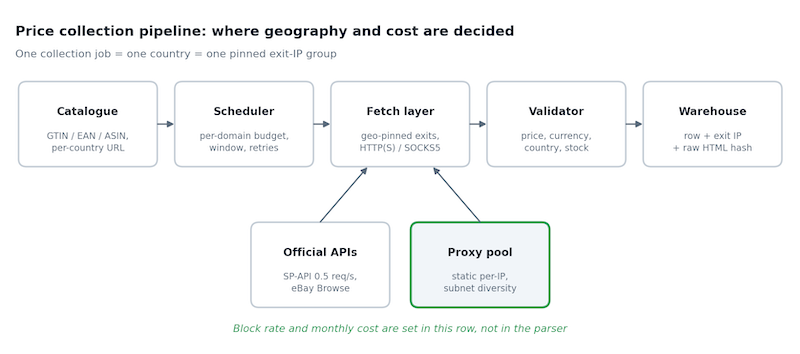
Figure 1. The country a retailer thinks you are in is decided in the fetch layer, one job and one pinned IP group at a time.
So the first infrastructure decision in retail price monitoring is not “residential or datacenter”. It is one country per collection job, pinned to a stable group of exit IPs inside that country.
That contradicts most scraping advice, which recommends rotating IPs per request for diversity. Price work wants the opposite, for the same reason a lab wants the same instrument: reproducibility. If yesterday’s £42.99 came from an address in Leeds and today’s £39.99 came from one in Glasgow, you cannot separate a price cut from a regional variation. Static allocation gives you a controlled variable; rotation gives you noise that you will spend two weeks explaining to the pricing team.
The trade-off is real. Static IPs accumulate history against a domain and get blocked faster if you push them hard. You buy reproducibility with a lower per-IP request ceiling.
Official APIs first, then the open web
Where you have credentials, use them. Amazon’s Selling Partner API exposes competitive pricing through its Product Pricing operations, and the published limits are tight: getItemOffers runs at 0.5 requests per second with a burst of 1, and getItemOffersBatch at 0.1 requests per second. Rate limiting uses a token bucket, so sustained overuse returns 429 and your client needs exponential back-off rather than a retry loop.
The limitation is scope. SP-API answers questions about marketplaces where you are already a selling partner. It says nothing about a competitor’s own web shop, a regional chain, or a direct-to-consumer brand site, and that segment is where a lot of category price movement starts. eBay’s Browse API and Walmart’s marketplace APIs have the same shape: useful, bounded, and no substitute for HTTP collection across the long tail where most competitor price tracking happens.
The workable split is an API for the marketplaces you can reach, HTTP collection for public product pages everywhere else, and the same request budget discipline applied to both.
Sizing the pool before pricing it
Retail price monitoring capacity is arithmetic, not intuition. Take a mid-size catalogue: 40,000 SKUs tracked across six countries. That is 240,000 URLs. Two passes a day gives 480,000 requests, and a realistic retry rate of 12% for timeouts, transient 503s and challenge pages takes it to roughly 540,000 requests per day.
Now the constraint that sets your bill. Decide how hard one exit IP may hit one domain. At one request every 12 seconds an address handles 300 requests an hour, which over a 12-hour collection window is 3,600 requests per IP per day. That gives 540,000 divided by 3,600, or 150 exit IPs.
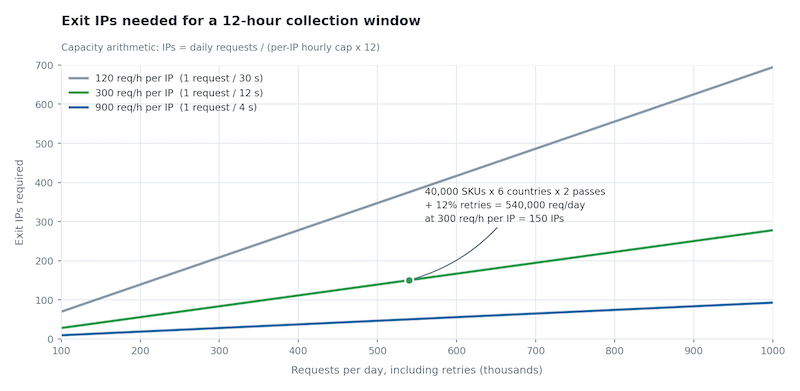
Figure 2. Pool size is set by the per-IP request ceiling you choose, not by catalogue size alone.
Halve the rate to one request every 30 seconds and the same workload needs 375 addresses. Push to one every 4 seconds and 50 will cover it, with a much higher block rate on any retailer running rate-based defences. Most teams settle between 200 and 400 requests per IP per hour on retail domains, then tune per domain from the measured 429 rate.
What the same workload costs across providers
The table below prices that exact retail price monitoring job: 150 static IPs, or the equivalent bandwidth if you buy per gigabyte. At roughly 250 KB per compressed HTML response with assets excluded, 540,000 requests a day is about 135 GB per day, or 4.05 TB per month. List prices were checked in August 2026 and change often, so treat them as the starting point for a quote rather than the quote itself.
| Provider and product | List price | 150 static IPs | Same volume per GB (4.05 TB) | What to check before buying |
| Proxys.io, foreign IPv4 (per IP) | from $1.47 / IP / mo | ≈ $221 / mo | not sold per GB | US, UK, DE, FR, ES, PL, NL and more; HTTP(S) and SOCKS5; shared IPv4 from $0.67 if up to 3 users per address is acceptable |
| Oxylabs, shared datacenter (per IP) | from $1.20 / IP / mo | ≈ $180 / mo | $0.59 / GB → ≈ $2,390 | 38 countries only; up to 3 users per IP; concurrent sessions drop from 100 to 10 per IP after 50 GB |
| Oxylabs, dedicated datacenter | from $2.25 / IP / mo | ≈ $338 / mo | not applicable | 188 countries, 1.9M IP pool, country-level targeting; 100 GB per IP fair-use threshold |
| Bright Data, shared datacenter | $1.00 / IP at the 100-IP tier | ≈ $150 / mo | $0.60 / GB PAYG → ≈ $2,430 | 100 GB per IP fair-use allowance; dedicated IPs are $1.70 each at the same tier |
| Decodo, dedicated datacenter | from $2.50 / IP / mo | ≈ $375 / mo | $0.45–0.60 / GB → $1,820–2,430 | dedicated IPs available in the US, UK, Germany and Japan only; shared pool is wider |
| Rotating residential (Bright Data, Oxylabs) | $2.50–5.00 / GB | not applicable | ≈ $10,100–20,300 | justified only on the domains that reject datacenter ranges; both vendors run KYC before activation |
Table 1. Monthly cost of 540,000 daily requests under per-IP and per-gigabyte billing.
The spread is the point. A 540,000-request day that datacenter addresses can serve costs about $221 a month on static per-IP billing. The same volume billed by bandwidth runs roughly $2,390 on a datacenter per-gigabyte plan and $10,100 or more on rotating residential: eleven times and forty-five times the static-IP figure.
Measure the difference instead of assuming it. Run one country’s job through datacenter IPs for a week, record the success rate per domain, and buy residential capacity only for the domains that actually fail. Worth checking too: Bright Data and Oxylabs both apply a 100 GB per IP monthly fair-use allowance on dedicated datacenter plans, so a 150-address pool carries 15 TB of headroom and the 4 TB workload above sits well inside it.
Failure modes that survive validation
Most retail price monitoring defects arrive with a 200 status code, which is why an error-rate dashboard on its own will never find them.
| Symptom | Usual cause | Detection signal | Response |
| 429 rate climbing on one domain | per-IP or per-subnet rate ceiling reached | share of 429s by domain and by /24 | lower the per-IP rate for that domain and add addresses from other subnets |
| 403, or 200 with a short challenge body | edge protection classified the request | response body under about 5 KB with a 200 or 503 status | back off, re-read robots.txt and any published crawl guidance, then move that domain to the retailer’s API |
| 200 with a null price field | price rendered client-side after load | null-price rate per domain per hour | headless render for that template only; keep plain HTTP for the rest |
| 200 with the wrong currency | the request exited from the wrong country | count of currency versus expected-country mismatches | pin the job to a single-country IP group and fail the row rather than converting it |
| Same SKU drifting a few percent between passes | regional store assignment changed with the exit IP | price variance for one SKU across IPs within one job | static IP allocation; store the exit IP on every row |
| p95 latency above 3 s while the median holds | oversubscribed shared pool | p95 against median, per proxy | move that domain to dedicated addresses and re-measure before renewing |
Table 2. Collection failures ranked by how easily they slip past a schema check.
The expensive row is the fourth one. A 403 shows up in your error rate and somebody fixes it that afternoon. A 200 carrying a German price into a UK index passes every schema check you have written, lands in the warehouse, and gets averaged into a report. Country and currency consistency belongs in the validator, next to the null check, not in a quarterly data review.
When the pool, not the code, is the constraint
Three properties decide whether a proxy pool holds up for retail price monitoring, and none of them appear on a pricing page. The first is subnet spread: 150 addresses drawn from two /24 blocks behave like two addresses to any edge that aggregates by network, so ask for the subnet distribution before you buy and check it again after every top-up.
The second is address history. Datacenter ranges get recycled, and an IP that spent last quarter on somebody else’s workload arrives carrying reputation you did not create. That is why a short paid trial against your own targets beats any published benchmark.
The third is tail latency. Oxylabs advertises a 0.222 s average response time and Decodo under 0.3 s, both measured against lightweight test endpoints rather than retail product pages loaded with third-party scripts. What sets your collection window is p95 under concurrency, and you have to measure that yourself.
Where a per-IP provider fits
For the 150-IP scenario, the deciding factors are per-IP monthly pricing, coverage of the specific countries in your catalogue, and SOCKS5 support for headless workers that authenticate at the transport layer. Proxys.io sits in that band: foreign IPv4 from $1.47 per IP per month across the United States, United Kingdom, Germany, France, Spain, Poland, the Netherlands and further locations, shared IPv4 from $0.67 when up to three users per address is acceptable, and premium residential from $3.60 per IP for the domains that refuse datacenter ranges, all with HTTP(S) and SOCKS5 on the same endpoint. Current locations and protocols are listed at Proxys.io.
The ceiling is worth stating plainly. A per-IP datacenter pool at that price will not carry you through the most heavily defended retail sites. For those, the honest options are residential addresses at two to three times the per-IP cost, the retailer’s own API, or a licensed feed. Any guide claiming a $1.47 address handles every target is selling something.
Legal boundaries that hold
Two US decisions frame the current position. In hiQ Labs v. LinkedIn the Ninth Circuit held that the Computer Fraud and Abuse Act does not reach automated collection of publicly accessible data. In Meta Platforms v. Bright Data, decided in the Northern District of California on 23 January 2024, Judge Edward Chen granted summary judgment to Bright Data on the contract claim, finding that logged-off collection of public pages was not “use” of Meta’s products under its terms.
The caveat matters more than the headline. hiQ still ended its litigation paying damages and destroying the data it had gathered, on contract grounds rather than under the CFAA. Public access is defensible; an agreement you clicked is a separate question.
For retail price monitoring the boundaries are narrow and easy to hold. Collect only what an unauthenticated visitor sees, never create accounts to reach member pricing, honour robots.txt and any published crawl guidance, keep request rates below anything that would affect the target’s service, and store facts rather than page copy. Prices are facts. Product photography and description text are not.
Operating it after launch
Alert on data shape, not only on HTTP status. Null-price rate per domain per hour moves days before your error rate does, and it is the cheapest canary in the system. Keep a hash of the raw HTML alongside every stored row: when the pricing team disputes a number, reproducing the exact page and the exit IP that fetched it ends the argument in minutes instead of days.
Keep a manual verification path too. Routing a browser through the same exit IP that produced a disputed row shows you the page a shopper in that country would see. A switcher such as ProxyControl does this without touching system-wide network settings, though it drives HTTP(S) endpoints directly and needs a proxifier for SOCKS5.
Then size the pool for the retries rather than the requests. A retail price monitoring job planned around 480,000 clean fetches that really needs 540,000 will run 12% past its window, deliver after the morning pricing meeting, and be written off as useless by people who will never see the 99.4% success rate you are proud of.