



For many retailers, the weeks around Black Friday and Christmas put the whole business to the test, and often the online store is where weaknesses show first.
Mobile devices are a big part of that. Adobe Analytics reports that mobile devices accounted for a record 63% of peak holiday spending, yet Finsi puts the average cart abandonment rate at around 80%. Slow pages, awkward mobile journeys and clunky checkouts cost sales just when demand is highest.
Speed is the second biggest factor. Akamai found that a delay of just 100 milliseconds in page load time, can reduce ecommerce conversion rates by 7%. Larger retailers can justify dedicated teams to keep refining the customer experience. Independent retailers and smaller brands rarely have that option. The Baymard Institute puts average online cart abandonment at 70.22%, largely because of complicated checkout processes.
As a result, many small merchants head into January knowing their website needs attention, but unsure how to fix it without a lengthy, expensive rebuild.
Why Websites Rebuild Often Stall
The problem is rarely a lack of ambition. A traditional rebuild means briefing an agency or freelancer, agreeing on a design, creating content and imagery, loading products and testing across devices.
Each step takes time and money, and each depends on someone else.
For a small team already juggling buying, merchandising and customer service, the project tends to slip down the list. The old site stays live, the issues remain, and the business reaches the next peak while facing the same pressure points.

What AI Website Builders Change
This is where AI website builders are starting to make a practical difference. Instead of working from a blank page or a fixed template, a retailer describes their business in a prompt. The tool then generates a complete website, including pages, copy, imagery and design.
For eCommerce, that can include a full online store with products, categories and checkout, ready to review in minutes rather than months.
The first version is a starting point, not the finished article. Retailers can refine the site with simple prompts, adjust the design visually, or hand it to a developer for deeper changes. For independent retailers, the appeal is clear. They can get a working foundation in place quickly, then spend their time on the things that set their brand apart: the range, the story and the customer experience.
How to Choose an AI Website Builder
Not every AI website builder suits a retail business, so it’s worth asking a few practical questions before committing.
Q. Can it run a store?
Look for proper ecommerce features, such as product management, discounts or coupons, and no cap on the number of products you can list.
Q. Will customers and search engines find it?
The site should be mobile-responsive and SEO-ready from the start, and multilingual support helps if you sell beyond one market.
Q. Who owns the site?
Some platforms keep websites tied to their proprietary ecosystem. With WordPress, website ownership is retained with its content, flexibility to scale and management as the business evolves.
Q. Where will it be hosted?
A good-looking store still needs reliable hosting, security and support, especially in peak season.
Cloudways AI Website Builder is one example that covers these points. It generates a WordPress or WooCommerce site from a single prompt and offers prompt, visual and code editing. Retailers get full WordPress admin access, and the site can be managed through chat. It can then be published to Cloudways managed hosting, either on an existing server or a new one, with 24/7 support.
To see how this works in practice, a retailer might start with a prompt like this:
Build an online store for an independent home and gifts shop based in Manchester. The brand is warm, modern and locally focused, with a cream and terracotta colour palette. Include a homepage with featured products, a shop page with categories for candles, ceramics and gifts under £30, an About Us page telling the shop’s story, a journal for gift guides, and a contact page. Set up the store so customers can browse, add to basket and check out on mobile. Use a friendly, personal tone.
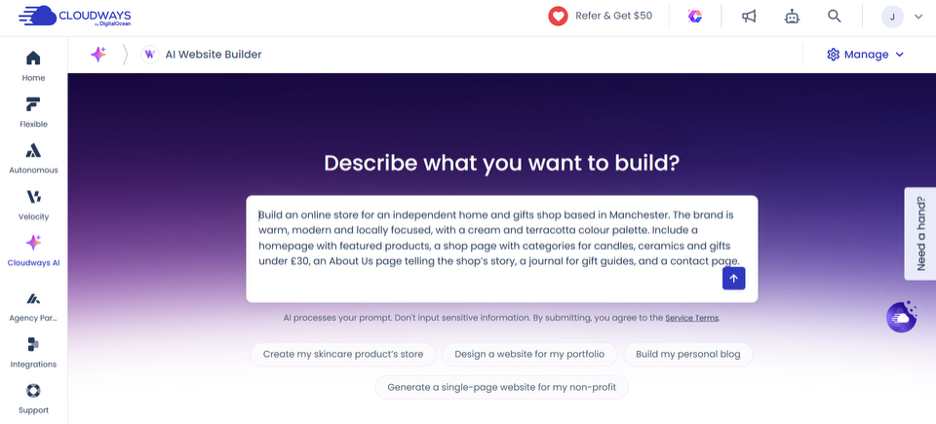
– The sample prompt entered into the AI Website Builder, before the site is generated. (Source: unified.cloudways.com)
From there, the site can be refined with follow-up prompts, such as asking for a different colour theme or an extra section, until it matches the brand. Here’s the live website link: https://wordpress-1203347-6778125.cloudwaysapps.com/
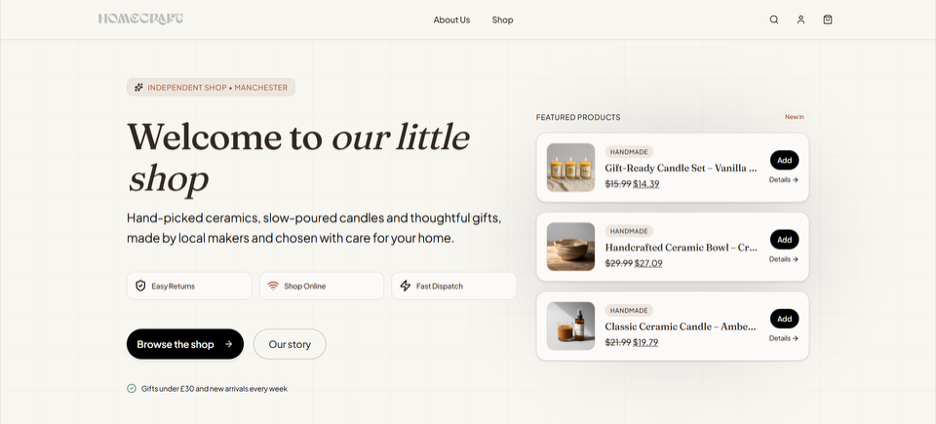
– The store generated from that prompt, including featured products and a clear route into the shop. (Source: cloudways.com)
The Case for Building With AI
The most obvious benefit is speed. A retailer can go from idea to a working store in minutes, then spend their time refining it instead of waiting for a first draft.
Cost control is the second. Cloudways AI Website Builder is priced per site, with hosting charged separately according to server size. The cost per site falls as more sites are added, and a 5-day free trial lets retailers test the builder before committing. Subscriptions can be cancelled at any time.
Monthly AI credits also give retailers a predictable allowance for multiple edits in a single prompt; making the use of AI credits efficient for more. Each site includes 20 credits a month, and more can be bought if needed.
Finally, the approach scales. Retailers with more than one brand, a seasonal pop-up or a new product line can build and host extra sites from the same account, all managed from a single dashboard.
Summary
Peak trading shows retailers what their online store can and can’t do under pressure. The weeks that follow are the best time to act on it.
Waiting for the next rush leaves little room to fix anything, and a rushed rebuild between October-November is rarely a good one but it allows time for testing. Cloudways Black Friday and Cyber Monday promotion of 80% for the first two months with promo code BFCM802, allows users to test their readiness, so starting January, the refinement process can give them a fully functional website.
For independent retailers and smaller brands, AI website builders offer a practical way to do that. They shorten the route from idea to a working store, keep costs predictable and leave the brand, the range and the customer experience in the retailer’s hands.
The next peak will arrive on schedule. The question is whether the website is ready for it.