


Retail refurbishments often have unusually tight programmes. Every additional day of closure can mean lost sales, while a delayed opening can disrupt staffing, stock deliveries, and marketing plans that have been arranged well in advance.
At the same time, there is little room for a poor finish. Customers see retail interiors at close quarters, often under bright lighting that makes inconsistent paintwork and surface defects particularly noticeable.
The answer is not simply to work faster. The biggest gains usually come from better sequencing, choosing suitable application methods and making sure each trade can complete its work without creating problems for the next. Decorating and finishing are areas where careful planning can make a meaningful difference to the programme.
Start with the programme, not the paint
A fast refurbishment depends on getting the sequence of work right.
Decorators arriving before surfaces are ready will not save time. Adding more people to the job will not necessarily help either if several trades are competing for access to the same area.
The Finishes and Interiors Sector publishes guidance for the fit-out and interiors industry, where planning, specification, and coordination are central to successful project delivery.
On a well-planned project, everyone knows when walls, ceilings, and joinery will be ready for preparation and decoration. Work can then progress into painting, snagging, and final inspection without unnecessary gaps between stages.
This becomes particularly important where a refurbishment is taking place overnight, in phases, or within a short store closure.
The decorating package may also extend well beyond walls and ceilings, taking in counters, columns, bulkheads, doors, display areas, and fitted joinery. Looking at these elements together makes it easier to decide where traditional application makes sense and where spraying could save valuable time.
Use spray application where it makes sense
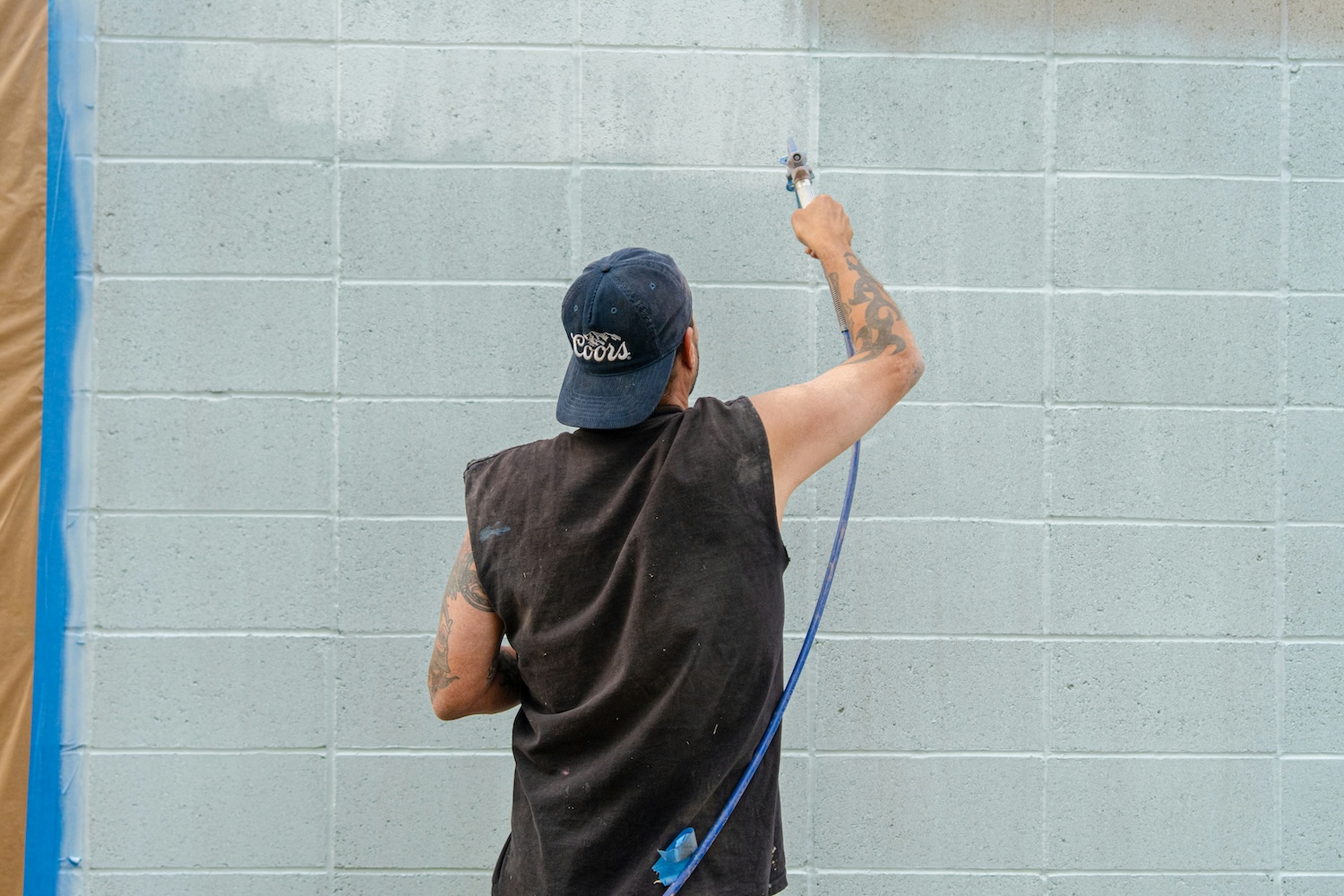
For larger areas, professional spray equipment can considerably increase the rate at which paint and coatings are applied.
Walls and ceilings are obvious examples, particularly in an empty retail unit where surrounding surfaces can be protected before work begins. Spray application can also be useful for doors, joinery, and repeated shopfitting elements where a controlled, consistent finish is required.
The equipment should be selected for the coating, surface, and finish required. There is no single spray system that is right for every part of a retail fit-out.
Paint type, material thickness, surface area, and the finish required all influence the choice of machine and spray tip. Spray Plant has produced a useful guide to choosing equipment for different types of work, looking at factors including project size, material, spray system, pressure and tip selection.
Covering several hundred square metres of wall and ceiling calls for a very different setup from finishing detailed cabinetry or other shopfitting elements. Making that distinction before work begins avoids losing time to unsuitable equipment, poor coverage, or unnecessary changes during the job.
Preparation still determines the result
Faster application does not mean less preparation.
Spraying puts even more emphasis on preparation because surface defects remain visible in the finished work. Poor filling, rough repairs, or inconsistent substrates will not disappear simply because the paint has been applied efficiently.
Masking also needs to be planned properly. Floors, glazing, lighting, finished joinery, and anything else that is not being coated must be adequately protected.
An empty shell is particularly well suited to spraying because floors, glazing, and other surfaces can be protected before decorating starts. A refurbishment taking place in a trading store requires a more selective approach, and brushes or rollers may still make more sense in certain areas.
The most effective contractors use the application method that suits each part of the project rather than trying to use the same approach everywhere.
Think about consistency across the whole store
Speed matters, but a retail interior also needs to look consistent once the work is finished. Retail lighting can expose surprisingly small inconsistencies. Spotlights, illuminated displays, and daylight from large areas of glazing can reveal changes in wall texture or uneven coverage that would be much less noticeable in other environments.
This becomes even more important in stores built around a restrained palette or a relatively small number of materials. With fewer visual elements competing for attention, the condition and finish of the surrounding surfaces become more prominent.
Spray application can help create a consistent appearance across large areas and repeated components. That can be valuable within a single store, but it also matters when a retailer is refurbishing several locations to the same design standard.
For brands rolling out a new store concept, consistency is part of the brief. A customer visiting the same retailer in Manchester, London, or Bristol should encounter the same level of finish.
Keep snagging under control
A long snagging list can undo much of the time saved earlier in a refurbishment. Poor preparation, inconsistent coverage, and damage caused by following trades all mean completed areas have to be revisited.
Sequencing is particularly important. There is little value in completing a wall ahead of the programme if shelving, signage, or services still need to be installed against it. Protecting completed finishes and agreeing when different trades can access an area helps prevent avoidable repairs towards the end of the job.
That matters because the final days before a store opens are rarely quiet. Fixtures are being installed, stock is arriving, merchandising teams are working, and final cleaning is taking place. Keeping decorating defects and repairs out of that period makes handover considerably easier.
Choose finishes for the way the store will actually be used
Retail interiors experience considerably more contact than many domestic spaces.
Stock is moved regularly, displays change, walls are cleaned, and customers pass through the same circulation areas throughout the day. Entrances, changing rooms, counters, and other busy areas can be particularly demanding.
The coating specification needs to reflect those conditions. Choosing a finish purely because it can be applied quickly is a false economy if it starts to look tired shortly after the store opens.
Durability, cleanability, and appearance should therefore be considered alongside application speed. The objective is to reduce the time required to complete the refurbishment without creating additional maintenance work afterwards.
Where the real time savings are
Completing a retail refurbishment faster is not about rushing the final stages. It is about removing the delays and duplicated work that add little to the finished store.
That means making sure surfaces are ready when decorators arrive, selecting equipment around the actual work, protecting completed finishes, and coordinating decorating with the trades that follow.
Spray application can form an important part of that approach. With the correct preparation and equipment in place, large areas and repeated elements can be finished quickly while maintaining the consistency expected in a professionally designed retail Environment.
The real advantage is not simply getting paint onto a wall faster. It is creating enough room. in the programme for the entire fit-out to be completed properly before the doors open.