

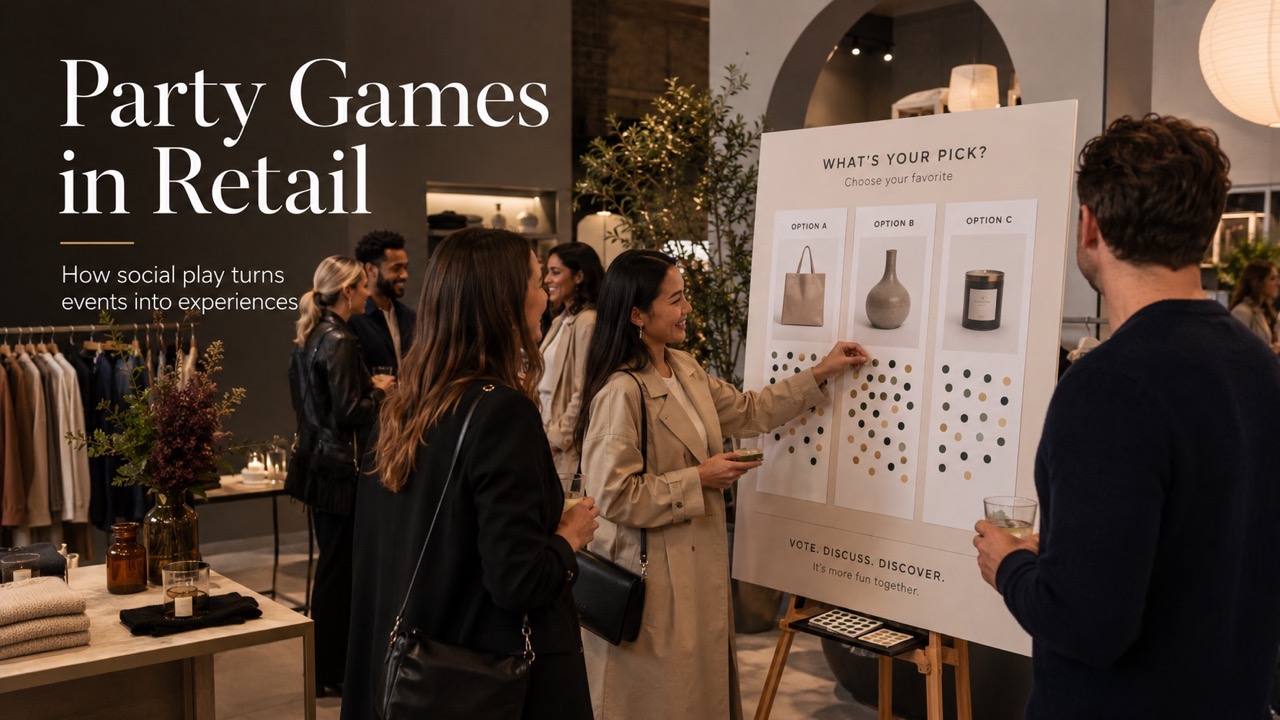


The most useful party games at a retail event are not necessarily the ones with the biggest screens, prizes or technology. Sometimes the strongest interaction starts with a question. Kiss Marry Kill, for example, works because everyone understands the basic forced-choice format almost immediately: three options, three decisions and usually a conversation about why somebody chose what they did. Gamerules is a useful reference for the basic rules and common variations of Kiss Marry Kill, which makes it easier to understand why the format is so easy to adapt. A retailer would obviously change the wording and subjects to suit the brand, but the underlying mechanic is valuable. It turns passive visitors into participants, gives strangers something to discuss and creates the kind of shared moment that a product display alone rarely produces.
That distinction matters because experiential retail has moved beyond simply making a store look impressive. Physical retail increasingly has to give people a reason to participate, not just observe. Retail Focus has previously highlighted gamified activations from brands such as Burberry, where visitors to pop-ups could use Snapchat interactions to unlock rewards, while Benefit Cosmetics incorporated a contactless arcade-style game into an in-store activation.
The opportunity for retailers is broader than installing expensive technology. Simple social games can do much of the same work at a fraction of the complexity.
Why do games work so well at retail events?
Walk into most product launches and the social pattern is predictable.
People arrive with whoever they came with. They look at the displays, accept a drink, perhaps speak to a member of staff and then retreat to the people they already know.
The space may be busy without ever becoming particularly social.
A game interrupts that pattern because it gives people permission to interact.
That is particularly useful at pop-ups, launches and community events, where the retailer often wants visitors to spend time in the space rather than complete a transaction as quickly as possible.
The important word is permission.
Most customers will not walk up to a stranger and ask which of three trainers they would keep for life. Put the same question on a card, however, and suddenly answering it becomes part of the event.
The awkwardness disappears because the game has started the conversation for them.
Gamification is already a recognised part of experiential retail. Mintel has pointed to interactive contests and challenges as a feature of beauty pop-ups designed to generate more engaging customer experiences.
But retailers often interpret gamification as technology.
It does not have to be.
The best retail games can be explained in 20 seconds
A retail event is not a board-game night.
Nobody has arrived expecting a ten-minute rules explanation, and every extra instruction creates another opportunity for someone to walk away.
That gives retailers a useful design rule:
If the customer cannot understand the game before a member of staff finishes explaining it, simplify it.
Forced-choice games are particularly effective for this reason.
Take the structure behind Kiss Marry Kill. Strip away the adult wording and almost any retailer can turn it into a brand-safe mechanic.
A fashion store might use:
Wear / Gift / Return
A food brand could try:
Breakfast / Dinner / Midnight Snack
A beauty launch could use:
Keep / Share / Swap
A furniture retailer might ask:
Living Room / Bedroom / Home Office
A travel brand could make it:
Weekend / Summer / Bucket List
Nothing complicated has happened.
The retailer has simply taken three products, destinations, styles or characters and asked customers to rank them.
Yet that small decision immediately reveals preferences and creates something to talk about.
Use the product as the game material
One of the easiest mistakes is building an entertaining activation that has almost nothing to do with the retailer.
People enjoy it, take the prize and leave.
If the game could be moved unchanged into a supermarket, cinema, sports shop and cosmetics store, it probably is not doing enough brand work.
The product should ideally become part of the mechanic.
Suppose a footwear brand is launching three new colourways.
Instead of putting the shoes on plinths and asking people which one they like, create a three-way choice:
Wear every day / Save for a night out / Give to a friend.
Now customers have to imagine the products in real situations.
A homeware store could place three chairs in front of visitors and ask which belongs in a dream apartment, which belongs in a hotel lobby and which they would actually buy.
A bookshop could ask customers to assign three new releases to:
Read tonight / Take on holiday / Give as a gift.
The customer is still looking at products.
The difference is that they now have a reason to evaluate, compare and discuss them.
Games are especially useful at pop-ups
Pop-ups have a structural problem that permanent stores do not.
People know they are temporary, which creates curiosity, but the retailer has limited time to turn that curiosity into a memorable experience.
The best pop-ups in 2026 are increasingly being judged less by novelty for its own sake and more by whether the experience gives people a meaningful reason to enter and engage. Industry analysis of current pop-up retail points toward interactive, experience-led formats rather than simple temporary shops.
A simple game can provide that reason immediately.
Imagine walking past a pop-up and seeing:
Which one would you choose? Vote inside.
That is much easier to understand than a paragraph describing a new collection.
The question creates an information gap.
People want to know what the three choices are. Then they want to know what everyone else chose.
A leaderboard can make the mechanic even stronger:
48% picked A.
37% picked B.
15% picked C.
Suddenly the activation has a live story.
Visitors are no longer just looking at a launch. They are contributing to it.
Keep the game social, not just competitive
Prizes are useful, but they can also change the atmosphere.
Once every activity becomes a competition for a voucher, people start optimising for the reward rather than enjoying the interaction.
For many retail events, the better goal is conversation.
That means asking questions where the answer itself is interesting.
“Guess how many objects are in this jar” gives people a reason to enter.
“Which of these three products would you take to a desert island?” gives them a reason to speak to one another.
The second mechanic is usually more valuable if the retailer wants a social environment.
There is a reason experiential marketing increasingly emphasises active participation rather than one-way communication. Interactive games turn the visitor from an audience member into someone who is doing something inside the brand experience.
That participation does not have to produce a winner.
Sometimes the debate is the reward.
Design games for people who did not arrive together
This is where retail games differ from normal party games.
At home, everybody has usually been invited by the same person.
In a shop, strangers may be standing next to each other.
The game therefore needs a low social cost.
Avoid mechanics that require customers to reveal anything genuinely personal.
Questions about relationships, income, politics, health or physical appearance are poor choices even when they might work among close friends.
The safest retail games create opinions without exposing private information.
Ask about taste.
Ask about fictional scenarios.
Ask about products.
Ask people to predict what the majority will choose.
That last option is particularly effective.
Instead of:
Which one do you prefer?
try:
Which one do you think Deventer will choose?
Now the visitor is not only expressing an opinion. They are trying to read the crowd.
Reveal the result later on a screen or through social media and the activity can continue beyond the store.
Turn waiting time into playing time
Retailers should also look at where boredom naturally appears during an event.
That is where a game belongs.
Queues for personalisation.
Waiting for fitting rooms.
Registration areas.
Product sampling.
Checkout lines.
The minutes before a demonstration begins.
Nobody wants another activity when they are already occupied. The ideal moment is when the customer has nothing else to do.
A cosmetics brand could place preference cards near a queue for makeovers.
A trainer launch could let people predict which colourway will sell out first while waiting for customisation.
A department store could put quick “this or that” questions between guests waiting to enter a ticketed activation.
The game is then not competing with the retail experience.
It is fixing a weak point in it.
Physical cards still have an advantage
Retail innovation often defaults to screens because screens feel measurable and modern.
But a stack of printed cards can be surprisingly effective.
They require no login.
No QR code.
No app download.
No Wi-Fi.
No explanation of where to tap.
Someone picks one up and starts.
For social activities, physical objects also give people something to gather around.
That does not mean digital interaction has no place. Burberry’s use of Snapchat within pop-up environments is a good example of technology being integrated into the experience rather than simply added for novelty.
The decision should depend on the purpose.
Use digital when you need personalisation, data capture, large-scale voting or something visually impossible in the physical world.
Use cards when you simply need two people to start talking.
Make the result visible
One of the simplest ways to make a game feel bigger is to show that other visitors have already played.
Put coloured tokens into transparent cylinders.
Move magnets across a wall.
Add stickers to three giant boards.
Update a digital voting percentage.
Let guests physically place a product card underneath their choice.
The mechanism becomes part game, part installation.
It also creates social proof.
A visitor who sees 200 votes wants to add the 201st.
And disagreement is useful.
If one option is unexpectedly winning, people start asking why.
That conversation is exactly what the retailer wanted in the first place.
Staff should play first
Nothing kills a social game faster than a staff member standing next to it waiting for somebody else to begin.
Employees should seed the behaviour.
Answer the question.
Argue about their choices.
Invite customers to disagree.
If the mechanic involves voting, put some votes on the board before doors open.
An empty participation wall looks like work.
A wall already covered in choices looks like an event.
Staff training should therefore include the game’s opening line, not just its rules.
There is a big difference between:
“Would you like to participate in our activation?”
and:
“Quick question: which of these three would you never wear?”
One sounds like marketing.
The other sounds like a conversation.
Know when not to gamify
Not every retail moment needs a game.
Luxury environments in particular may benefit from quiet, personalised service rather than noise and constant interaction. Broader retail thinking in 2026 has increasingly stressed meaningful human service, emotional relevance and well-executed physical experiences over adding technology or spectacle simply because it is available.
The game has to match the brand.
A streetwear launch can tolerate shouting, fast voting and playful rivalry.
A fine jewellery appointment probably cannot.
The same mechanic can still work, but the tone changes.
A luxury fragrance store might quietly present three scent cards and ask:
Dinner in Paris / Weekend on the Amalfi Coast / Hotel bar in New York?
That is still a game.
It simply does not look like one.
Measure conversations, not just participants
If 500 people play a game and nobody remembers the brand, the activation has underperformed.
Retailers should therefore look beyond participation numbers.
Did visitors stay longer?
Did they handle products while playing?
Did they speak to staff?
Did people photograph the result board?
Did they share their choice online?
Did the game lead naturally into a product demonstration or purchase?
The best retail game creates a bridge.
It takes someone from walking past to stopping, from stopping to participating, from participating to talking, and from talking to actually engaging with the brand.
That is a more useful sequence than simply handing someone a discount for spinning a wheel.
The simplest game may be the most effective
Retail events are often designed as if memorable experiences require increasingly elaborate technology.
Sometimes they do.
But there is another route.
Give people three choices.
Make the decision slightly difficult.
Let them see what everyone else chose.
Then give them somewhere to argue about it.
That basic structure is why party games have survived for generations, and it is exactly what makes them useful in retail.
They organise social interaction.
For pop-ups, launches and in-store events, that can be more valuable than another screen.
A customer who walks through a beautiful space may remember what it looked like.
A customer who spends five minutes defending an absurd choice to three strangers has a story to tell when they leave.