



Performance apparel is moving beyond traditional sportswear. Consumers increasingly expect clothing to combine mobility, durability, technical fabrics, practical storage, and everyday styling. For retailers, that shift creates opportunities across activewear, outdoor apparel, workwear, teamwear, and lifestyle categories.
The challenge is separating lasting product changes from short-lived aesthetics. Retail buyers should evaluate performance apparel trends through fabric technology, use cases, inventory economics, customisation, and customer education.
Technical Features Are Moving Into Everyday Clothing
One of the clearest performance apparel trends is the integration of technical construction into familiar silhouettes. Stretch denim, reinforced pockets, moisture management, articulated cuts, and abrasion-resistant materials are no longer limited to uniforms or specialist outdoor products.
Products such as 5.11 tactical jeans illustrate this crossover. The Defender-Flex Slim Fit Jean uses 10-ounce mechanical-stretch denim with a cotton-polyester construction, seven pockets, bar tacks at high-stress points, and a conventional slim-jean silhouette.
For retailers, the commercial opportunity is not simply selling “tactical” products. It is merchandising technical benefits in formats customers already understand. A shopper may not be looking for specialist apparel but may value stretch, storage, reinforcement, and a cleaner fit.
Utility Styling Is Becoming More Mainstream
Utility-inspired clothing is increasingly influencing mainstream fashion. Retail Focus has highlighted the broader movement toward authentic functional clothing, including the growing influence of technical and outdoor aesthetics on high-street fashion.
Cargo pockets, workwear fabrics, adjustable hems, reinforced panels, and technical outerwear can therefore sit beside conventional fashion categories rather than being isolated in a purely outdoor department.
Retailers should organise products according to customer use cases. “Travel,” “commute,” “weekend outdoor,” and “everyday utility” can communicate value more effectively than relying solely on technical terminology.
Durability Is Becoming a Value Proposition
Consumers evaluating performance apparel increasingly need a reason to pay more than they would for basic clothing. Durability gives retailers a concrete value story.
Retail Focus notes that workwear buyers are placing greater emphasis on stronger fabrics, colour retention, and long-term garment performance. These expectations can extend into broader performance categories as consumers compare cost per wear rather than ticket price alone.
Retail buyers should examine seam construction, reinforcement points, fabric weight, abrasion resistance, stretch recovery, and washing requirements before adding products to an assortment.
Build Better Product Specifications
Useful merchandising data can include:
- Fiber composition and fabric weight
- Stretch construction
- Moisture-management properties
- Reinforced stress areas
- Pocket configuration
- Care requirements
- Intended weather conditions
These specifications help sales associates and ecommerce customers understand why one garment costs more than another.
Fit Is Becoming More Specialised
Performance apparel is moving away from a single generic athletic fit.
Customers may want compression for running, relaxed silhouettes for mobility, slim utility pants for everyday use, or articulated cuts for activities requiring repeated bending and extension.
That creates assortment complexity. Every additional fit, colour, and size creates another SKU, so retailers need detailed sell-through data before expanding range depth.
Retail Focus recently emphasised how apparel margins can be damaged by both overstock and stockouts, particularly when buyers lack accurate style- and SKU-level information. Performance apparel retailers should therefore track demand by fit and size rather than evaluating only total style sales.
Moisture Management Is Becoming a Baseline Feature
Moisture-wicking performance was once a strong differentiator. In many athletic categories, customers increasingly treat it as an expected feature.
Retailers should look beyond whether a product is simply labeled moisture-wicking. Fabric construction, garment ventilation, drying speed, weight, and fit all influence real comfort.
This creates an opportunity for better staff training and product content. Explaining why a mesh panel, lightweight knit, or particular fabric structure matters can improve conversion more effectively than repeating broad marketing claims.
Customisation Is Expanding Performance Apparel
Customisation is another trend retailers should monitor, particularly in team sports, clubs, schools, corporate fitness programs, and organised events.
Current custom track uniforms demonstrate how far personalisation has moved. Sports Gear Swag offers track apparel with customisable team names, numbers, colours, logos, multiple fabric options, and sublimated printing, including adult and youth sizing.
For retailers, customisation can shift the sales model from individual transactions toward higher-value group orders. The operational requirements are different, however. Artwork approval, sizing collection, production lead times, reorders, and individual personalisation need controlled processes.
Sublimation Is Supporting More Complex Visual Design
Sublimation has become important in performance teamwear because designs can be integrated into the garment without adding thick decorative layers.
Sports Gear Swag currently uses sublimation across its custom track offering and positions it as a way to create lightweight apparel with detailed, vibrant designs.
This matters for retailers serving clubs and teams because customisation no longer has to mean placing one logo on a standard blank garment.
Complex gradients, patterns, team colours, names, and numbers can become part of the complete design.
Performance and Lifestyle Merchandising Are Converging
The physical retail environment is also changing.
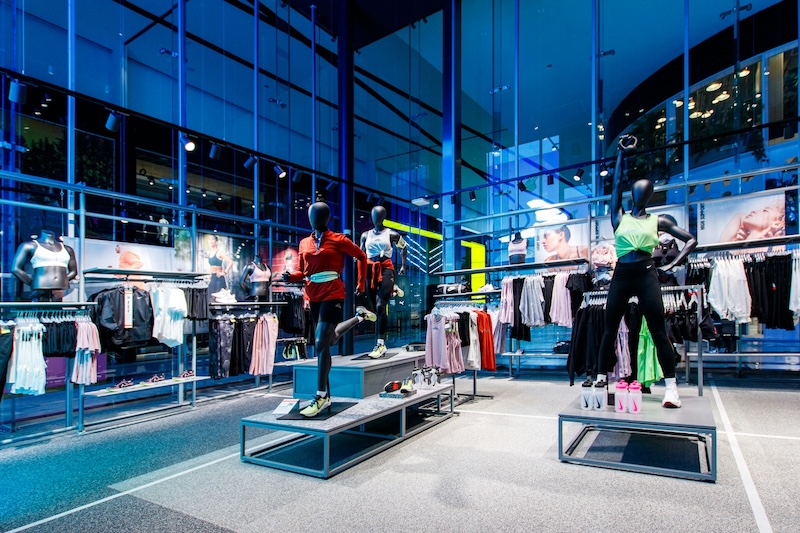
Technical brands are increasingly presenting performance products through lifestyle-oriented stores, community programming, and product education. Retail Focus has documented this direction in performance retail, including La Sportiva’s expansion across climbing, trail running, hiking, and apparel within a unified retail concept.
That means performance apparel should not always be merchandised as equipment.
A technical pair of pants can be styled with everyday footwear. A running jacket can be presented as lightweight travel outerwear. A performance top may work across training and casual wardrobes.
Retailers Need Tighter Inventory Discipline
Performance apparel can create significant SKU proliferation.
A single garment may include men’s and women’s fits, several lengths, multiple colours, extended sizing, seasonal fabrics, and different technical specifications. Team products create additional complexity through customisation.
Monitor the Metrics That Protect Margin
Retailers should track:
- Full-price sell-through by SKU
- Size-level stockouts
- Replenishment lead time
- Markdown percentage
- Returns by fit
- Inventory aging
- Gross margin by style
- Demand by channel
Retail Focus notes that waiting too long to identify slow-moving apparel can convert a manageable markdown into a clearance problem. Retailers need in-season visibility rather than waiting until the end of a collection to review performance.
Product Education Will Become More Important
Technical apparel creates a communication problem. Customers cannot always see stretch recovery, abrasion resistance, moisture management, or reinforcement by looking at a garment on a rack.
Retailers should make those benefits easier to understand through product displays, comparison charts, knowledgeable staff, ecommerce specifications, and practical demonstrations.
The strongest performance apparel assortment is not necessarily the one with the most technical features. It is the assortment where technical features solve recognisable customer problems.
What Retailers Should Do Next
Performance apparel is becoming broader, more technical, and more integrated with everyday fashion.
Retailers should watch the movement of utility features into lifestyle clothing, stronger demand for durability, increased fit specialisation, customisation, and the continuing convergence of performance and fashion merchandising.
Buying teams should respond with disciplined testing. Introduce new technical categories in controlled quantities, measure performance at SKU level, collect return reasons, and expand only where customer demand supports deeper inventory.
The retailers that perform best will not simply follow performance apparel trends. They will understand which features customers genuinely use, communicate those benefits clearly, and manage the resulting assortment without sacrificing margin.