





If you are here for the quick answer because your boss is breathing down your neck about moisture damage costs, here it is. Silica Gel is your safe middle ground that works well in most moderate places. Molecular Sieves are the expensive beasts you need for extreme heat or when you need practically zero humidity. Activated Clay is the cheap option that works great for bulk stuff provided it doesn’t get hotter than 50°C. That is the gist of it. But if you are signing off on a procurement budget for high-value electronics or pharmaceutical shipments, you know that a “gist” isn’t enough to prevent corrosion or mould. You need the chemistry.
I have spent enough time looking at ruined cargo to know that saving ten pence on a desiccant packet can cost ten thousand pounds in rejected product. It is a painful equation.
At a glance comparison data
I put this table together so you can see the numbers side by side. Most people just look at the price tag & stop there. That is usually a mistake.
| Desiccant Type | Absorption Capacity | Temp Range | Relative Cost
|
|---|---|---|---|
| Silica Gel | High (30-40% w/w) | Up to 85°C | Moderate |
| Molecular Sieves | Fast Kinetics (~20%) | High (up to 200°C+) | Premium (£££) |
| Activated Clay | Moderate (~25%) | Low (Stop at 50°C) | Low (£) |
| Calcium Chloride | Very High | Variable | Low-Mid |
| Activated Alumina | Moderate | High | Mid |
You look at that and think why would I pay for Molecular Sieves if Silica absorbs more? It seems logical. But absorption capacity isn’t the whole story. It is about the speed and the conditions.
Silica Gel is the versatile all rounder
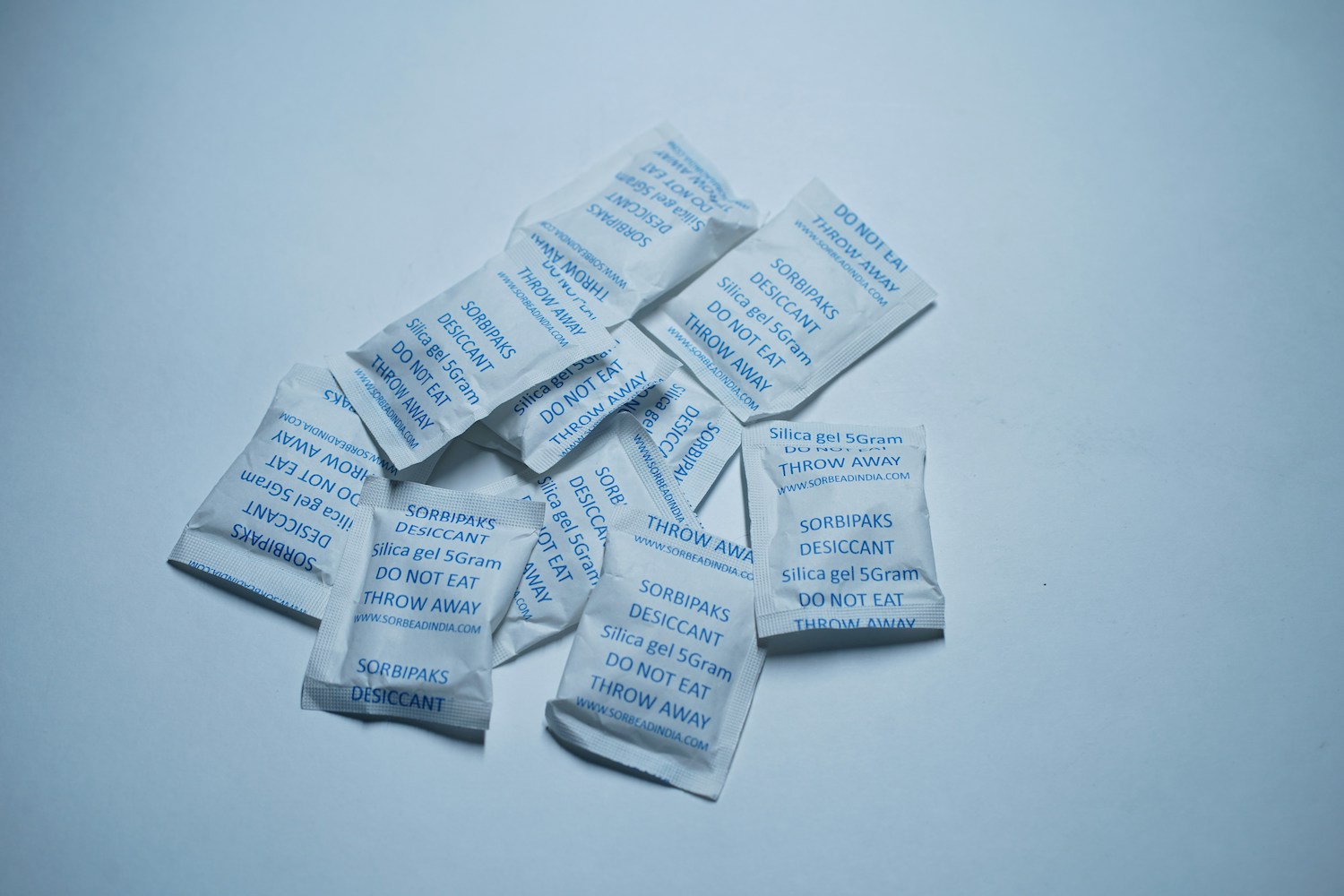
Everyone knows Silica Gel. It’s the one in the little white packets that say “DO NOT EAT” inside your new trainers. In the industrial world, we view Silica Gel bags as the reliable standard. It is a form of silicon dioxide that is synthetically manufactured. It has a high absorption capacity, taking in about 30% to 40% of its own weight in moisture.
That is impressive.
The beauty of Silica Gel is that it is chemically inert. It doesn’t react with things. It is non-toxic and approved for food contact, which makes it the go-to for vitamins, dried meats, or leather handbags. It works best in moderate humidity environments. Think of a standard warehouse in the Midlands or a shipping container that isn’t sitting on the equator.
It holds onto that moisture pretty well until you hit about 85°C. After that, it might start letting go. So if you are shipping something that gets baked in the sun, you might want to pause and think.
Molecular Sieves are the high performance specialist
Here is where we get into the heavy lifting. Molecular Sieves are synthetic zeolites. They are engineered with precise pore sizes. They are aggressive.
While Silica Gel slowly sips moisture, Molecular Sieves grab it violently. They are incredibly fast. But the real reason you pay the premium price – and yes, they are significantly more expensive, often in the £25/kg range compared to peanuts for clay – is their performance in extremes.
They work when it is bone dry. Even if the relative humidity (RH) is below 10%, Molecular Sieves will still hunt down water molecules and trap them. Silica Gel gets lazy at low humidity. It stops trying. Molecular Sieves don’t stop.
Also, heat.
These things stay stable up to 200°C or more. If you are in aerospace or you are manufacturing electronics where a soldering process involves high heat, this is your only real choice. It is also the standard for pharmaceuticals where zero moisture is tolerated because degradation means the drug doesn’t work. You don’t cheap out on life-saving meds.
Activated Clay is the cost effective workhorse
Let’s be honest about budgets. Sometimes you just need to keep a bunch of steel parts from rusting in a crate and you have very little money to do it. Enter Activated Clay, often called Bentonite.
It is naturally occurring. It is basically dirt that has been activated to suck up water. It is the cheapest option by a mile, usually around the £1.50/kg mark. For general preservation, it is fantastic. It absorbs about 25% of its weight. It is eco-friendly because, well, it’s clay.
But there is a catch. A big one.
It gives up easily. Once the temperature hits 50°C, Activated Clay can actually release the moisture back into the package. This is a disaster if you are shipping through a tropical zone or your container sits on a hot tarmac in Dubai. It can’t accommodate the heat spikes.
I have seen companies switch to Clay to save money, only to have their machinery arrive with surface rust because the container got too hot. It is a false economy if you don’t know your supply chain climate.
Rounding out the top five
The title promised five Industrial Desiccants, so I am not going to leave you hanging with just three.
Calcium Chloride is another one you see a lot, especially in those hanging poles inside shipping containers. It has a massive absorption capacity, much higher than silica gel. But it turns into a liquid brine as it absorbs water. You have to be careful with containment. If that brine leaks, it is corrosive.
Then there is Activated Alumina or sometimes Calcium Oxide. We usually see Activated Alumina used for air drying or gas purification rather than packaging. It is very porous and good for filtering things out of gas streams. It is not something you typically toss in a box with a circuit board, but in industrial processing, it is vital.
Real world scenario matching
I find that people get bogged down in the data sheets and forget the application. Let’s look at where these actually belong.
Scenario A: Shipping a MRI machine.
This is high value. High sensitivity. You use Molecular Sieves. You cannot risk a speck of corrosion on the electronics, and the cost of the desiccant is a fraction of the machine’s value.
Scenario B: Pallets of steel automotive parts.
You are moving tons of metal. The packaging is basic. You use Activated Clay. It is cheap, you need a lot of it, and as long as it doesn’t get insanely hot, the oil on the parts plus the clay will keep the rust away.
Scenario C: Consumer electronics headphones.
Silica Gel. It looks clean, it handles the box environment well, and it is safe if the customer touches it.
Scenario D: Container Rain.
You are shipping coffee beans & you are worried about condensation dripping from the container ceiling. Calcium Chloride poles are the answer here. They drink up the moisture from the air volume of the container.
Why price isn’t the only factor
I get it. You have a spreadsheet and the Clay looks so much better for the bottom line. But you have to factor in the “failure cost.”
If Silica Gel saturates, it just stays there. It doesn’t generally leak. If Calcium Chloride leaks, it eats metal. If Clay gets hot, it reverses. If Molecular Sieves get full, they stop, but they hold on tight.
Also, think about dust. Clay can be dusty. If you are in a cleanroom environment making microchips, you can’t have bentonite dust floating around. Molecular Sieves generate almost no dust. These are the little operational headaches that don’t show up on a price per kilogram chart.
And then there is the reusable factor. Silica Gel can be dried out and reused. It’s rare in industrial logistics – usually, we toss it – but it is possible. Molecular Sieves are harder to regenerate without specialised equipment.
Final Thoughts
Choosing a desiccant feels like a small decision until you open a container and find fuzzy mould.