





The dual screen relationship between social media and TV has long been understood, but our recent study ‘The Point of Social’ highlights that one of the most under used media channel partnerships is actually OOH and social, and this is particularly true in a retail environment.
The way people use social media changes dramatically when they’re out and about in the world and nowhere is that shift more commercially valuable than in the retail space.
At home, social media is largely passive. It’s habit driven, doomscrolling through boredom, but out of home, and especially in retail environments, social media behaviour becomes more active, more intentional, and crucially, closer to purchase. The study shows that social usage in these environments is not just more varied but fundamentally different in nature. People are more likely to explore products, and search for reviews about their purchase considerations. Exploring for products or services on social when OOH is 21% vs 13% when at home. But this rises significantly in retail environments, rising to 28% in shopping centres and 31% in-store.
This shift matters because it reframes how we should think about social’s role in the retail journey. We’ve long optimised social for reach and engagement, but in retail environments it behaves much more like a conversion channel. Social activity out of home is 75% more likely to lead to a purchase compared to at-home usage.
Yet at exactly the moment when social becomes more valuable, it paradoxically becomes less effective. The report identifies an 11% drop in attention to social ads during the daytime, the very period when most out-of-home social usage occurs.
This is the tension at the heart of modern retail media planning: intent is high, but attention is fragmented.
This is where OOH plays a critical role, not as a supporting channel, but as a structural one.
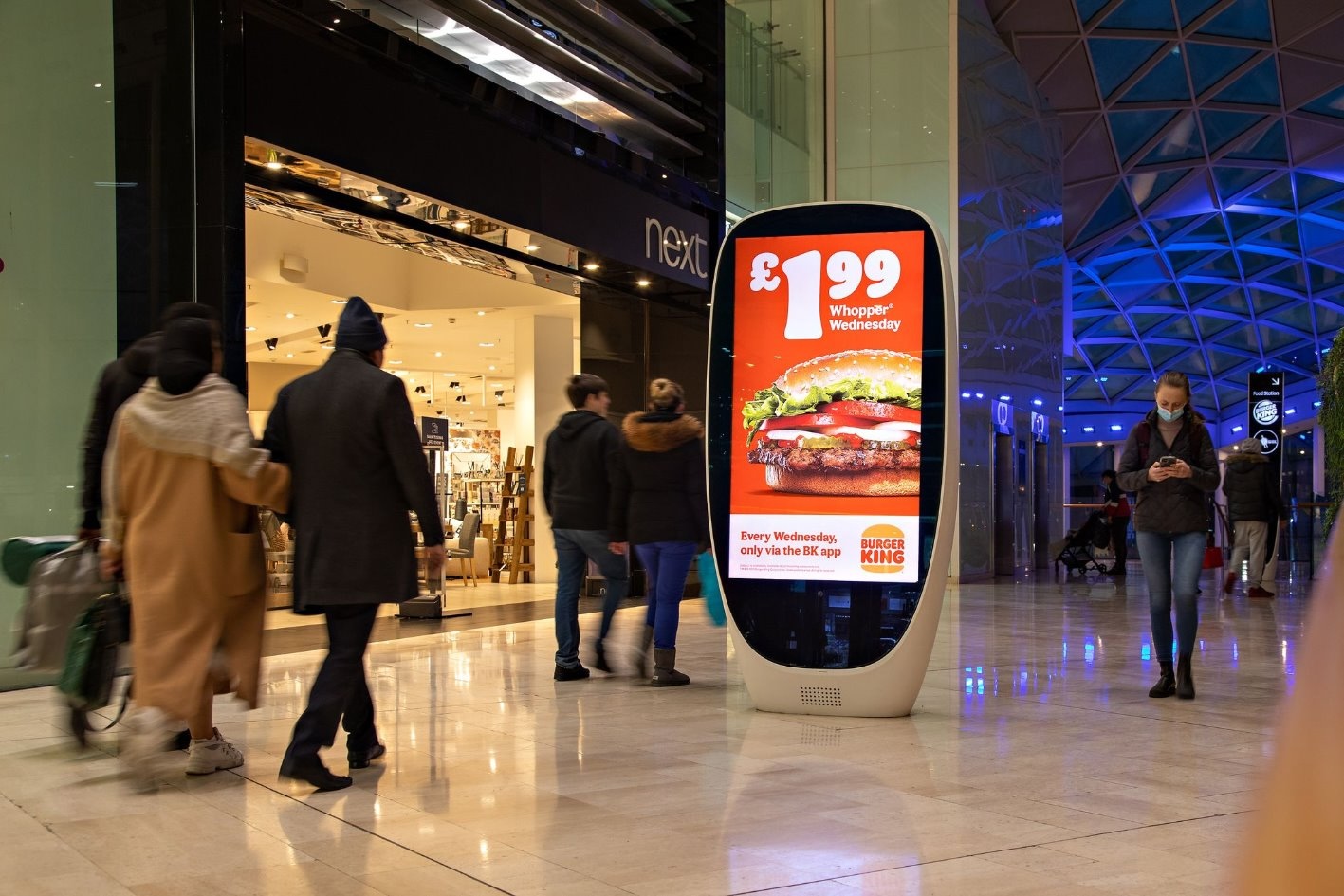
OOH is uniquely designed to operate in high-distraction environments. It is unavoidable and captures attention in the physical world, often at key retail environments such as high streets, shopping centres, and transport hubs where decision-making is already happening. More importantly, it doesn’t just drive awareness; it primes behaviour.
For retail brands, this has profound implications. It suggests that OOH is not just a top-of-funnel awareness driver, but a catalyst that makes bottom of funnel channels work harder.
What emerges is a more sequential view of the customer journey. OOH creates the trigger: it introduces the brand, frames the offer, and builds mental availability in the real world. Social then captures the response, allowing people to explore, validate, and ultimately convert. When planned together, rather than in silos, the effect is additive and measurable. There is already a plethora of evidence that campaigns combining OOH and social deliver stronger brand impact and significantly higher business outcomes, including uplifts in sales, profit and market share.
Nowhere is this more relevant than in retail, where decisions are often fluid, social, and influenced by immediate context.
Another important dimension is the social nature of “out-of-home social”. The study highlights that 44% of social sessions out of home happen in company, compared to just 23% at home, and are nearly 5 times as likely to occur when we are with friends.
This has two implications. First, it highlights the importance of the role of influence in groups, purchase decisions are more likely to be discussed, shared, and validated in real time. Second, it elevates the importance of creative. In retail environments, advertising isn’t just competing for individual attention, but for collective attention. Work needs to be not only noticeable, but talkable. Brands need culture to thrive and culture is built by groups of people.


So, what does this mean for marketers?
First, retail media planning needs to consider a shift from channels to moments. The question is no longer “how much social versus how much OOH,” but “where is the consumer, and what are they trying to do?” Retail environments are high-intent, high-context moments, both OOH and social need to be designed around that reality.
Second, sequencing matters. OOH should be used deliberately to trigger intent at physical touchpoints, near stores, along commuter routes, within shopping destinations. Social should then be structured to capture that intent in real time, providing the information people are actively seeking, such as social proof, availability, reviews etc.
Third, consistency is critical. The priming effect only works if people recognise the connection between what they see on the street and what they see in their feed. Distinctive assets need shared visual codes, and coherent messaging.
Finally, measurement needs to evolve. If OOH and social are planned as a connected system, they need to be evaluated as one. Focusing on channel-level metrics risks undervaluing the combined effect which, as our study proves, is where the real gains lie.
So, as retail becomes a media environment in its own right the relationship between OOH and social must become symbiotic. In retail today, the path to purchase doesn’t start on a screen. It starts on the street.