







There is a quiet contradiction at the heart of modern retail. Everyone agrees that experience matters. And yet, genuinely memorable retail experiences remain surprisingly rare.
Walk through any major shopping district, from London to Dubai to Shanghai, and you will find stores that are visually impressive, digitally enhanced, and conceptually ‘experiential.’ Yet very few of them stay with you. Fewer still pull you back.
The issue is not a lack of investment. It is a lack of clarity. Experience has been widely adopted as a goal. But it is rarely understood as a decision.
Were the wrong questions asked?
For years, the industry has been asking: “How do we create an experiential store?” It sounds like the right question. It isn’t. From a customer’s perspective, every store is already experiential. Every space creates a feeling. Every interaction leaves an impression. Every visit becomes, however faintly, a memory.
The real question is sharper, and far less comfortable: What is this store for?
Not operationally. Not aesthetically. Strategically. Because if a store cannot answer that question clearly, no amount of experience design will fix it.
From Selling Products to Justifying Presence
Physical retail is no longer competing on access to product. That battle is over. E-commerce solved for availability, price comparison, and convenience at a scale that physical retail cannot, and should not, try to match.
The moment a product became purchasable anywhere, the store lost its default justification. What replaced it is not ‘experience’ as a layer. It is purpose as a filter, one that highlights uniqueness.
If a customer can get what you sell without visiting you, then your store must offer something else, something that exists only in that place, at that moment, with those people.
What Research Actually Shows
When you strip away industry language and ask customers directly what matters in-store, the answers are disarmingly simple. The product still matters, but the service matters even more. The space, nonetheless, shapes how both are perceived. And increasingly, a fourth element emerges: participation. Not interaction in the superficial sense. Not screens. Not gimmicks. Participation as in: Am I involved? Am I part of something?
Because the difference between a satisfactory experience and a memorable one is not intensity. It is the unexpected alignment between what the customer hoped for, and what they didn’t know they needed. That is where memory forms.
| THE FOUR DIMENSIONS OF IN-STORE VALUE
, Product, what you offer , Service, how you engage , Space, what you shape , Participation, whom you invite |
The Myth of Maximum Experience
One of the most persistent mistakes in retail strategy today is the assumption that more experience equals more value. It doesn’t. Not every store needs to be immersive. Not every location should be theatrical. Not every customer is looking to be engaged. In fact, neurodivergent individuals, now estimated between 20 and 50% of the global population, tend to shy away from overstimulating stores. (To learn more about this, we invite you to consult Elisa Servais’ masterclass on neuroinclusive retail design and leadership: https://worthyretail.com/worthy-retail-masterclasses/elisa-servais-phd/). Experience is not a volume dial to turn up. It is a precision tool. Used correctly, it creates emotional peaks and long-term memory. Used indiscriminately, it creates noise, cost, and confusion.
“The most effective retail strategies are not the most experiential. They are the most intentional.”
Designing Across the Spectrum
Physical retail does not operate in a single format anymore. It operates across a spectrum, and each format plays a different role, serves a different purpose, and demands a different experiential register.
| PERMANENT | Consistency, accessibility, and the reliable expression of brand values at scale |
| FLAGSHIP | Brand universe, identity depth, and the full articulation of what the brand stands for |
| POP-UP | Intensity, urgency, cultural relevance, and the power of the temporary |
| ACTIVATION | Campaign amplification, traffic generation, and moment-specific storytelling |
The mistake is not choosing the wrong format. It is expecting one format to do everything. A flagship cannot replace a network. A pop-up cannot sustain a relationship. A standard store cannot carry brand storytelling alone.
The strategy lies in the combination, and in knowing where to place experiential investment, and at what intensity.
The Return of an Old Truth
There is a tendency to frame experiential retail as something new, but it isn’t. Historically, commerce was never purely transactional. Markets were social events. Bazaars were designed for discovery and time spent. Department stores turned shopping into theatre.
What changed was not the nature of commerce, but the conditions around it. Digital convenience stripped away the necessity of visiting a store. What remains is the choice to visit. And choice demands justification.
The Role of Space Today
In this context, physical space takes on a different role. It is no longer just where the transaction happens. It is where the brand becomes real. Where abstraction turns into material. Where digital relationships become physical encounters. Where belonging, if it exists, becomes visible.
This is why the most effective stores today do not try to replicate the online experience. They do the opposite, focusing on what cannot be digitized: human expertise, sensory depth, spatial storytelling, and social presence. Not as decoration. As structure.
The Hidden Variables: Coherence and Complementarity
Many brands understand the elements of experience. Fewer execute them coherently, where each element completes the other rather than simply coexisting.
A beautifully designed store that does not align with brand identity creates dissonance. A highly immersive activation disconnected from broader strategy becomes forgettable. Good intentions do not compensate for poor integration.
Experience is not built through isolated moments. It is built through consistency, across every touchpoint, from window display to staff interaction, from product presentation to digital integration, from flagship to smallest format. And it is sustained through frictionless connections between those touchpoints.
Every touchpoint either reinforces the brand or weakens it. There is no neutral ground.
Why ‘Unexpected’ Matters
One of the most overlooked insights in retail experience design is the role of the unexpected. Meeting expectations creates satisfaction. Exceeding them creates memory. But exceeding expectations does not mean doing more. It means doing something meaningful and relevant that the customer did not anticipate.
This could be a level of service that feels personal rather than scripted. A spatial detail that invites pause rather than movement. An interaction that shifts the customer from observer to participant. The key is not scale. It is resonance.
The Strategic Questions
The future of physical retail will not be defined by technology, nor by design trends. It will be defined by strategic clarity. These are not creative questions, they are strategic ones, and they must be answered before design begins:
| BEFORE EXPERIENCE, ASK
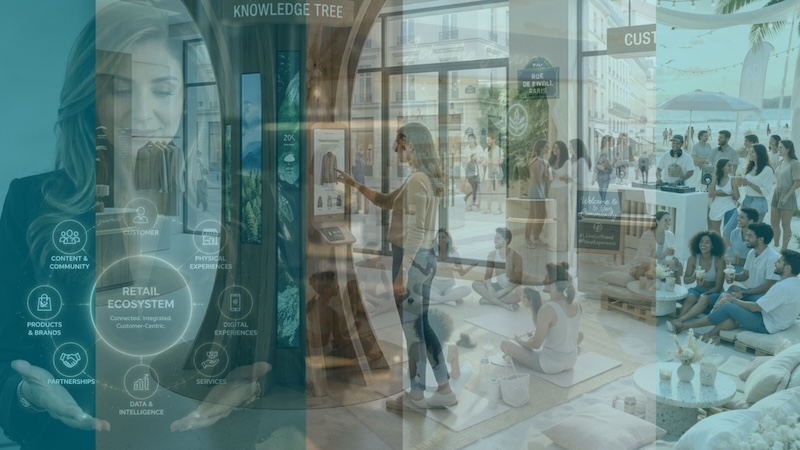
, Why does this store exist? , Who is it truly for? , What role does it play in the wider ecosystem? , What kind of experience is appropriate here, and what is not? |
Experience is often treated as an output, something added at the end of the process. It is the result of every decision that came before.
It is what customers perceive when strategy, design, operations, and brand all align, or simply fail to.
Experience is not the strategy. It is the proof that your strategy works.
And in a world where customers no longer need to visit your brand, proof is everything.